The Mirrors in the Torus
A table that multiplies rows by columns, read as a circle, is a torus: mirrors at every scale, a way to see primes, and the same opposition in Fibonacci and Lucas.
What I saw
In 2021 I started looking at a table that multiplies the numbers along the top by the numbers down the side, and writes each result as a single digit: add its digits until one is left (the digital root). The shapes inside it were not random. Numbers came in pairs that mirrored each other, and every pair added up to the same total.
I know this is modular arithmetic, and that Gauss laid it out in the Disquisitiones Arithmeticae. I am not adding to that. I am describing what the table looks like when you stop calculating with it and just look at it, and what I think it is telling us.
In base 10, the single digit is the remainder after dividing by 9, so this is the mod 9 table. Zero and 9 are the same point seen from two sides: arrive from the left and you call it 9, arrive from the right and you call it 0. That is why, in the old casting-out-nines check, you can ignore every 9 and every pair that adds to 9.
The eight sequences I saw first
In mod 9, each multiplier writes its own line, and there are eight of them. Reading across, with 0 and 9 as the same point:
| Multiplier | What it writes | How I describe it |
|---|---|---|
| 1 | 1 2 3 4 5 6 7 8 | ascending |
| 2 | 2 4 6 8 1 3 5 7 | evens ascending, then odds ascending |
| 3 | 3 6 9 3 6 9 … | the same three numbers, forever |
| 4 | 4 8 3 7 2 6 1 5 | two descending lines woven together: 4 3 2 1 and 8 7 6 5 |
| 5 | 5 1 6 2 7 3 8 4 | the opposite of 4: the same structure, ascending |
| 6 | 6 3 9 6 3 9 … | the mirror image of 3 6 9, a permutation |
| 7 | 7 5 3 1 8 6 4 2 | the opposite of 2: odds descending, then evens descending |
| 8 | 8 7 6 5 4 3 2 1 | the opposite of 1: descending |
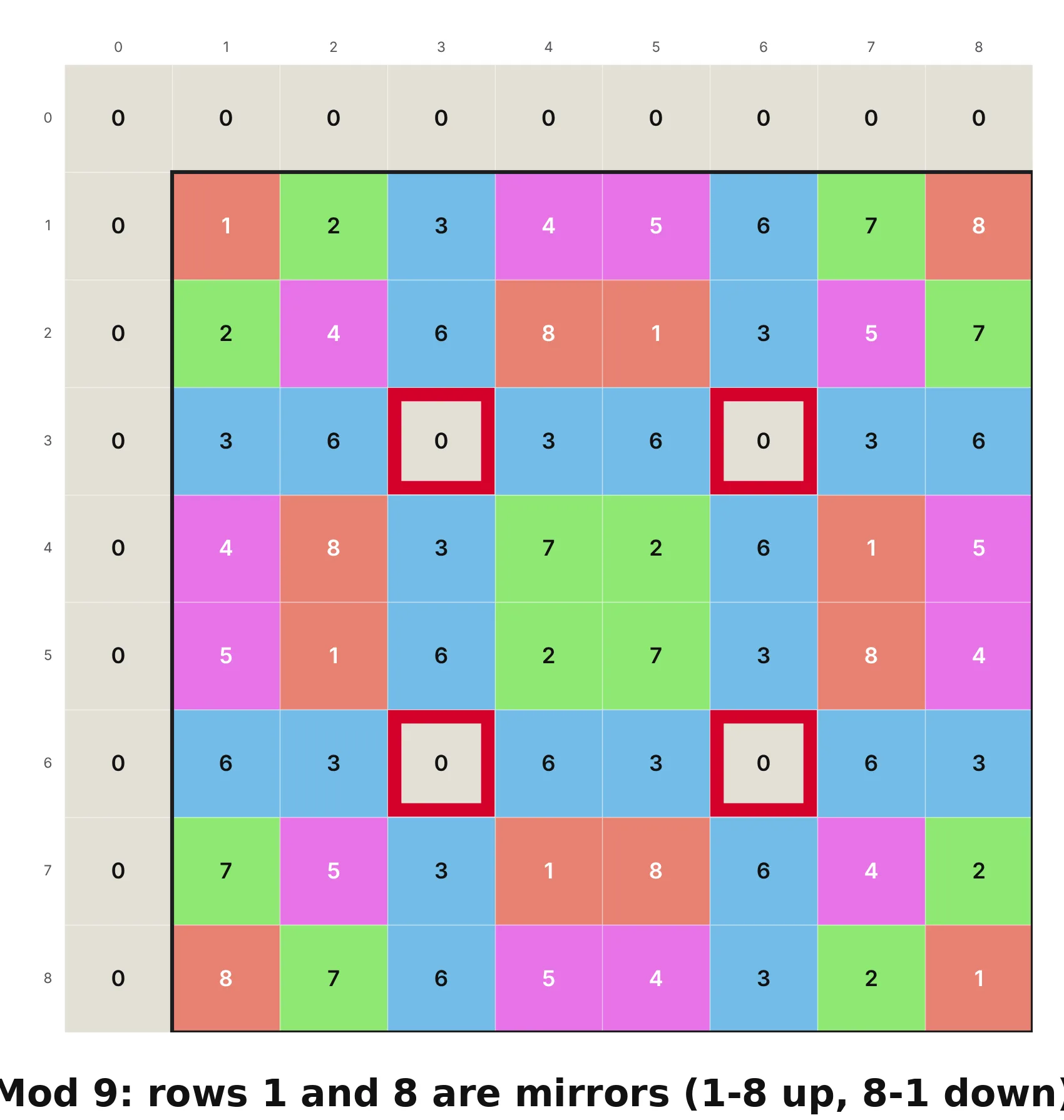
Rows 1 and 8, 2 and 7, 3 and 6, and 4 and 5 are mirrors of each other. The same thing happens going down the columns.
Why I call them families
In the first table where I saw all this, I started from 12 days, and the sequences came in groups: 1-4-7, 2-5-8 and 3-6-9. I knew those groups from Marko Rodin's vortex based mathematics, which many mathematicians do not count as mathematics. I mention it only because it is where I first met the idea.
The reason for the families is plain. They are the remainders after dividing by 3, hidden inside mod 9. Multiplying by 3 sends every number into the 3-6-9 family, and it never leaves, which is why that row repeats forever. Reflecting around 9 turns 1-4-7 into 8-5-2, so the first two families are mirrors of each other, and 3-6-9 is its own mirror (6-3-9).
When I started from 1 instead of 12, the families faded: you only see 3-6-9 and its reverse. The structure stayed the same.
It is a circle, so the table is a torus
A modulus groups numbers, and grouping puts them on a circle: after 9 comes 0 again, like a clock that closes at 12. Everything a circle has, the numbers inherit. The numbers along the top are one ring. The numbers down the side are another. The table multiplies one ring by the other, and two rings crossed like that make a torus. Cut it open and flatten it, and you get the table, which wraps around left to right and top to bottom.
In my Lab I watch sequences as circles for the same reason. The mirrors are easiest to see there. Lab: sequences as circles
The millions of shapes you can find in these tables come from five rules. Each one follows from a single line of algebra, and each holds for every modulus m:
- It repeats every m steps, across and down. This is the torus.
- Rows k and m − k are opposites. Their values always add up to m. In mod 9, row 1 climbs 1 to 8 while row 8 descends 8 to 1. Rows 2 and 7, and 4 and 5, pair up the same way.
- The diagonal is a mirror, because a × b is the same as b × a.
- Each square turns into itself after a half-turn. Flip it upside down and it looks the same.
- The perfect squares sit on the diagonal and read the same both ways inside each square, because (m − n)² gives the same remainder as n².
In mod 9, rows 3, 6 and 9 never leave the family 3, 6, 9, because 3 and 6 share a factor with 9. The other numbers fall into two more families, 1-4-7 and 2-5-8. Base 10 happens to have a modulus that is 3 times 3, and that is where the three families come from.
Here is the mod 9 table. Rows 1 and 8 are mirrors of each other: one climbs from 1 to 8, the other falls from 8 to 1.
 (enlarge picture)
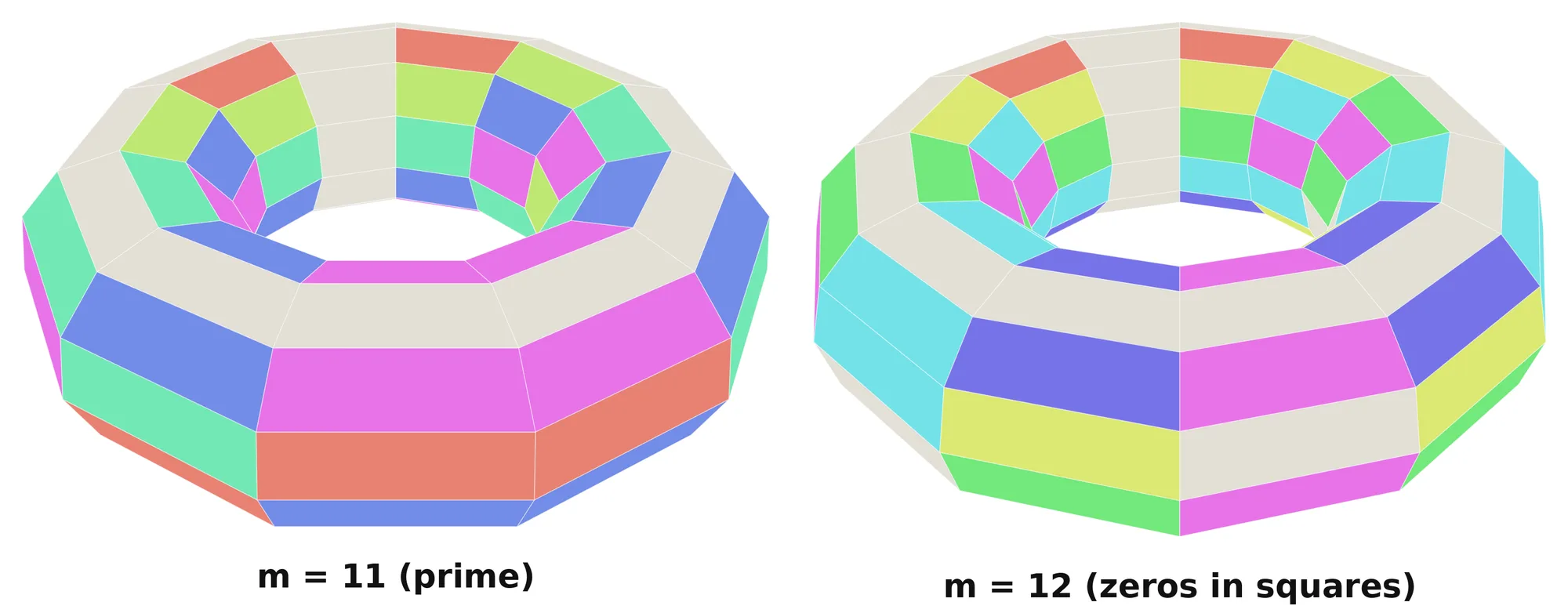
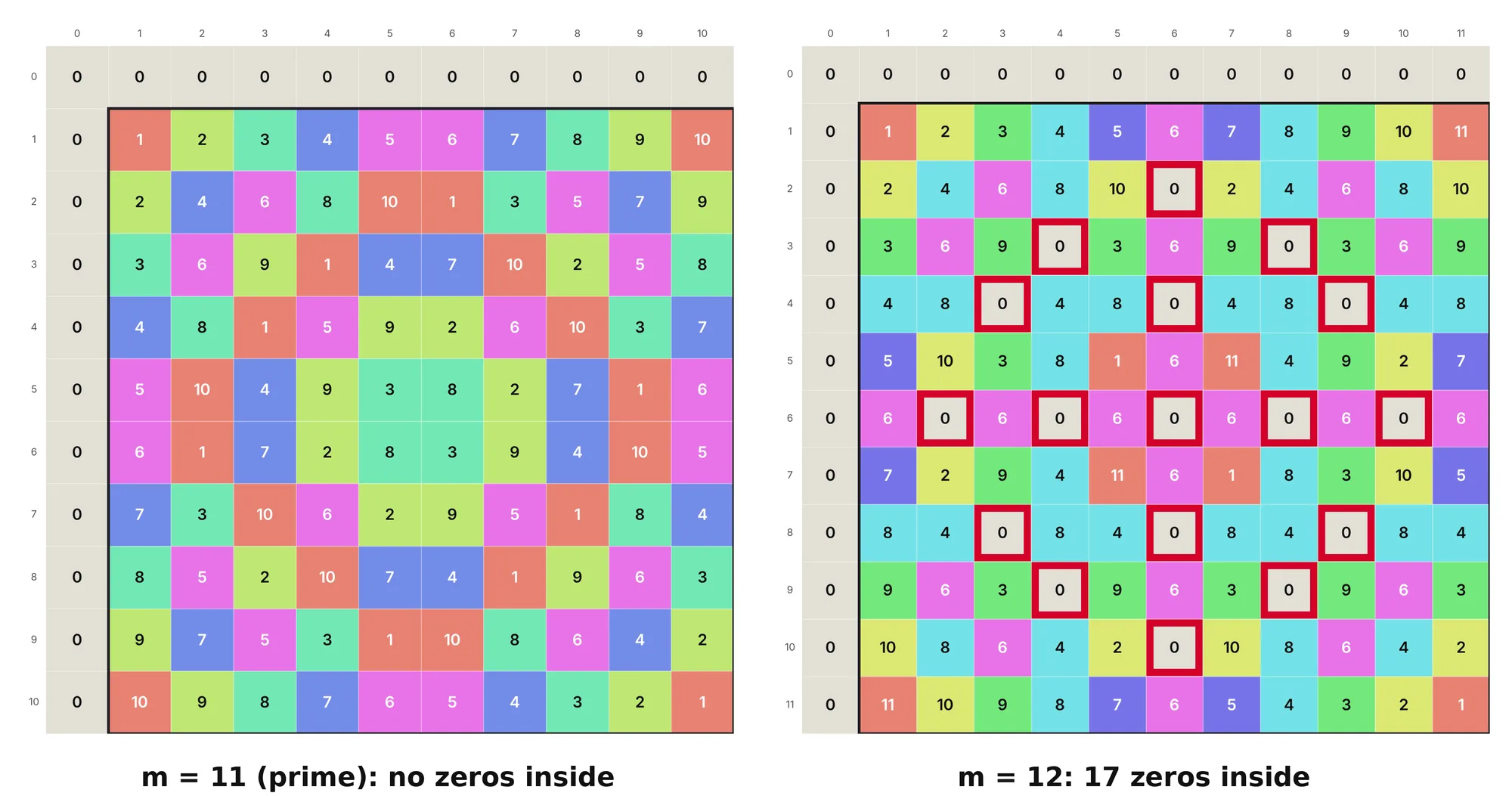
Now wrap that table around, so the right edge meets the left and the bottom meets the top. The zero row and the zero column become two seams that cross the doughnut, and the zeros inside the squares show up as islands. Here are m = 11 and m = 12 wrapped:
 (enlarge picture)
Blocks mirror blocks
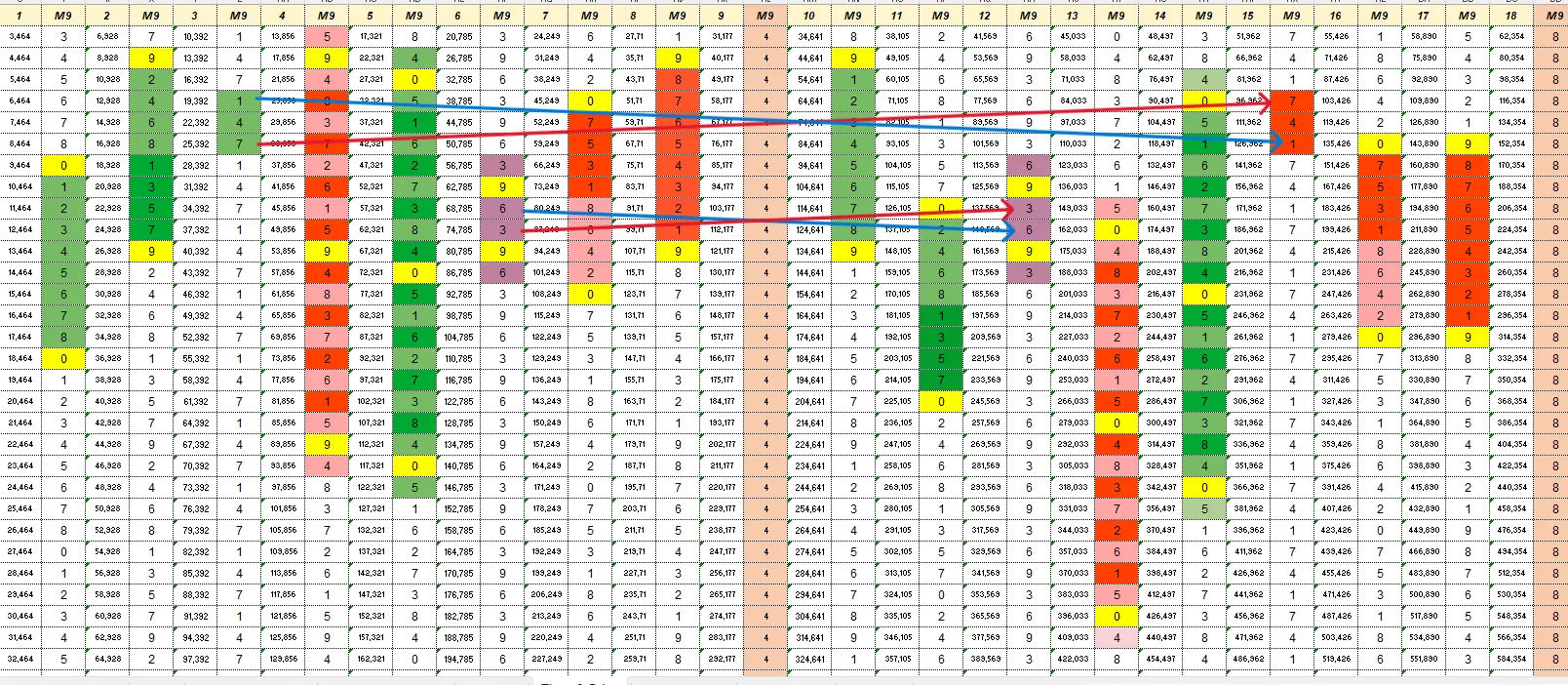
Rule 2 says that row k and row m − k are opposites. It holds at every scale. Take any run of whole blocks, one block, three blocks or seven, and read it from its far end. Row 1 from the end is the opposite of row 1 from the start, row 2 from the end the opposite of row 2, and so on.
The reason fits in one line. A run of K whole blocks has K × m rows, and the row K × m − j gives (K × m − j) × b = K × m × b − j × b, which leaves the opposite of what row j gives. So a block mirrors a block, and a group of blocks mirrors a group of blocks. It is the same behaviour as the palindrome of the Pentametric Cycle, where the cycle reads the same forwards and backwards.
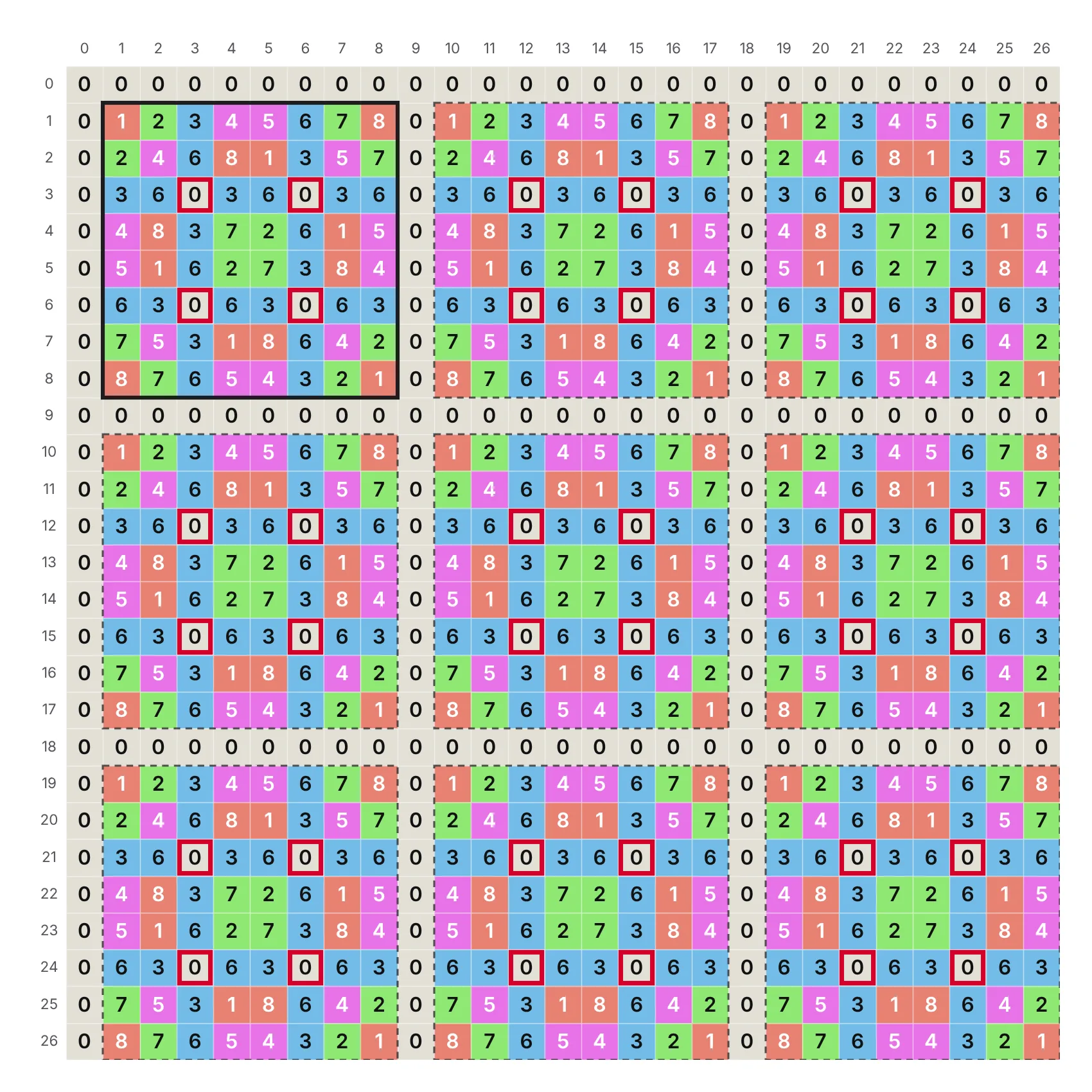 (enlarge picture)
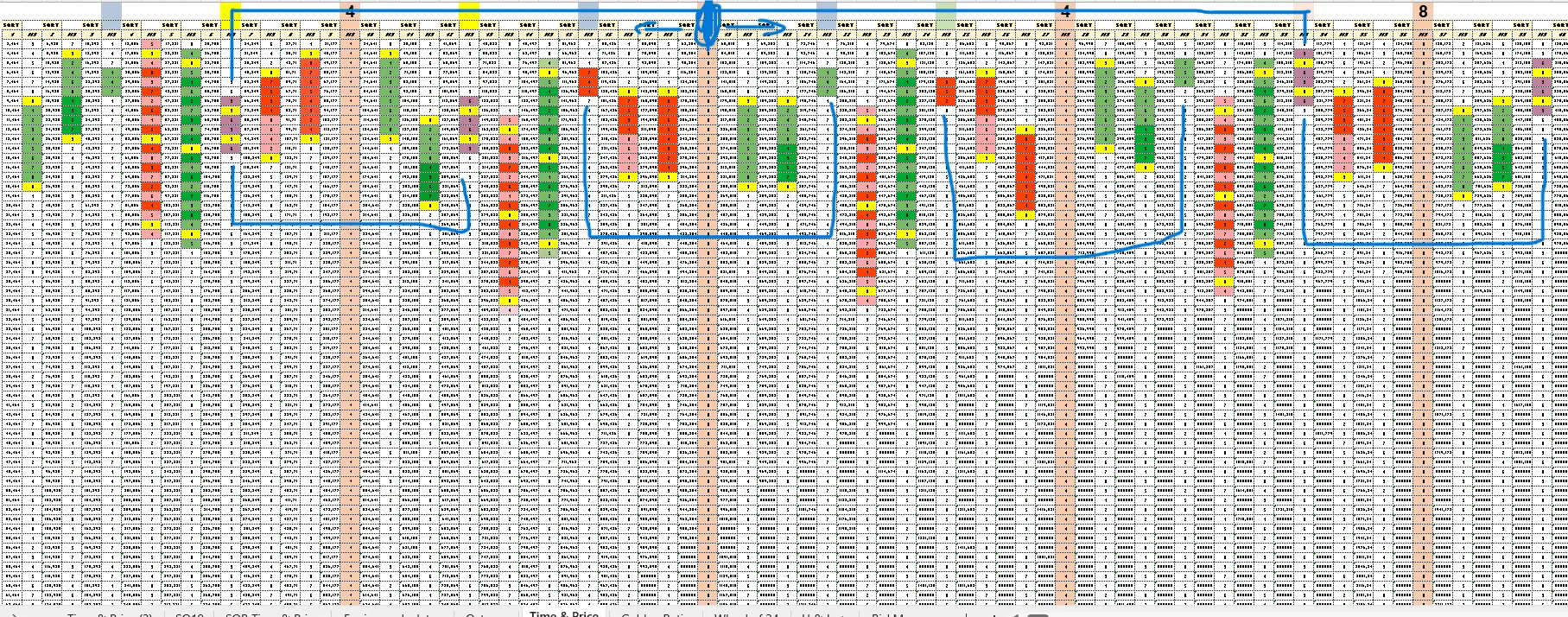
This is the same thing in my own spreadsheet. The blue lines join blocks that mirror other blocks, and groups of blocks that mirror groups of blocks:
 (enlarge picture)
It is not special to base 10
In base b, the digital root is the remainder after dividing by b − 1. So base 8 gives the mod 7 table and base 5 gives the mod 4 table, and each shows all five rules. Here is base 8, with the zero written as 7:
1 → 1 2 3 4 5 6 7     6 → 6 5 4 3 2 1 7     (up and down)
2 → 2 4 6 1 3 5 7     5 → 5 3 1 6 4 2 7     (evens then odds, reversed)
3 → 3 6 2 5 1 4 7     4 → 4 1 5 2 6 3 7
Base 5 is the same idea in four steps: row 1 is 1 2 3 4, and row 3 is 3 2 1 4.
So the mirrors do not belong to base 10. They belong to the circle, to every modulus. What base 10 adds is that its modulus, 9, is 3 times 3, which is where the 3, 6, 9 family comes from.
You do not have to take my word for it. I built a page where you pick the modulus and watch the mosaic change: Mirrors in the Torus, interactive. Try 9, then 8, then 12, then 24.
Primes leave their mark
Take the square of the table from 1 to m − 1, the part between the zero borders. If m is prime, there is never a zero inside it. A product of two numbers smaller than a prime cannot be a multiple of that prime. If m is not prime, there are always zeros inside, because m has smaller factors that multiply back to it. So the table itself tells you whether m is prime, and it works for any modulus, not only 9.
| m | Zeros inside the square |
|---|---|
| 4 | 1 |
| 6 | 4 |
| 8 | 5 |
| 9 | 4 |
| 12 | 17 |
| 24 | 53 |
Primes have no zeros at all. Here are m = 11 and m = 12 side by side; the red boxes mark the zeros inside the square of 12.
 (enlarge picture)
The single-digit view adds a second signature. There, the numbers 9, 18, 27 and so on all become a 9, and each of those values appears exactly once in every row. So the square of a prime p holds exactly this many 9s:
| p | 2, 3, 5, 7 | 11 | 13 | 17 | 19 | 29 | 37 |
|---|---|---|---|---|---|---|---|
| 9s inside | 0 | 10 | 12 | 16 | 36 | 84 | 144 |
These 9s are real residues, not zeros. A prime's square has no zeros at all, while a composite's always has some. I checked both statements by computer for every modulus up to 200, and they hold every time. Whether that is the beginning of something bigger, I do not know. But it is a neat way to see a prime: it is the square with nothing extra inside.
How I got here
I did not start with mirrors. I started by reverse-engineering a growth rule from my own tables. Here is how it went.
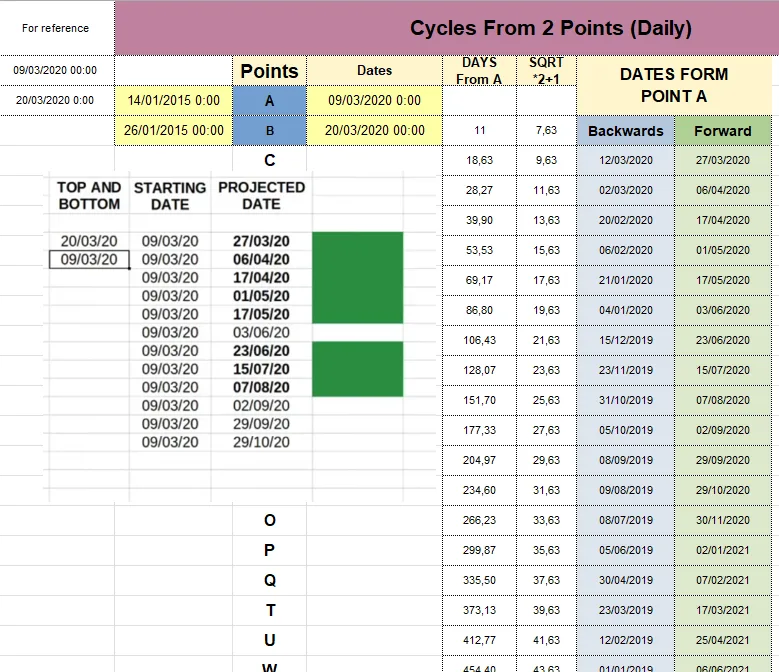
In 2021 I started reading markets. The charts seemed to move in patterns, so I looked for anyone who had found them. I came across a video of a man who used a "growth formula" to find pivots. It was not reliable (the video itself showed the misses), but I thought the misses might have a particular cause. He showed a table of dates without the formula behind it, so I worked it out from the dates.
Take two dates, A and B, and count the days between them (11 in his table). Then take the square root of that number, multiply by 2 and add 1: 7.63. Add 7.63 days to A and you get the first projected date. For the second one, count the days from A to that projected date (18.63) and do the same: 9.63 more days. I rebuilt his table this way and got exactly his dates, and I also ran it backwards in time as a check.
 (enlarge picture)
That left me with a question: why twice the square root, plus 1? The rule I wrote down looked like this: each step adds twice the square root of the current value, plus 1.
Written that way, it is simple: each step adds exactly 1 to the square root. Start from 1 and you get the perfect squares 4, 9, 16, 25. Start from 11 and the decimals never change: the square roots go 3.3166…, 4.3166…, 5.3166…
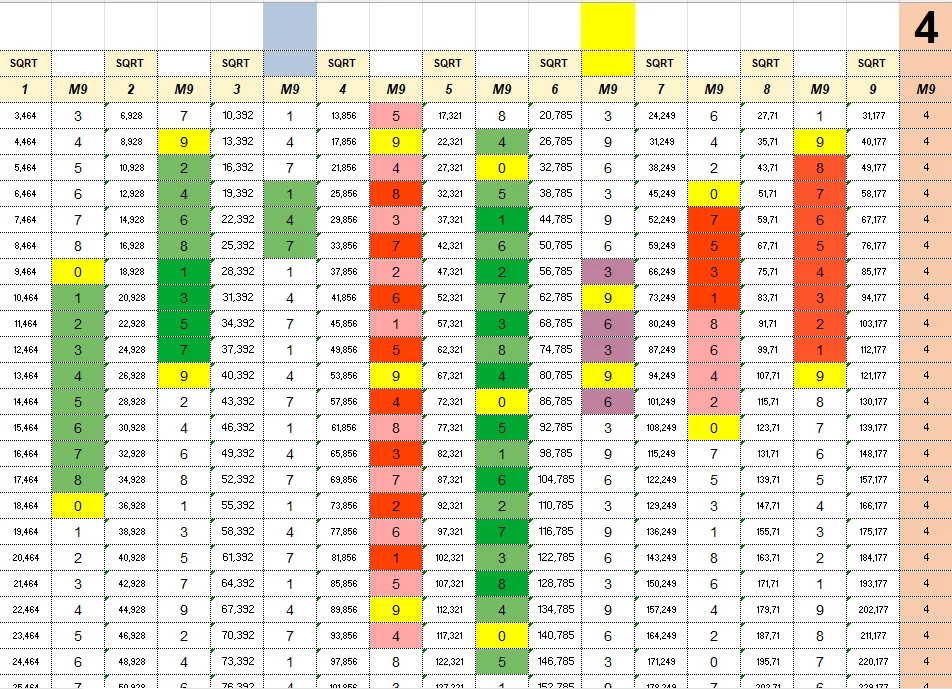
To see what was behind it, I made a column of the square roots of the day counts (√11 = 3.317, √18.63 = 4.317, and so on). Then I multiplied them by 2, by 3, by 4 and onward, and took the digital root of every result, to see whether a pattern would appear. With a starting difference of 12 days (14 January 2015 to 26 January 2015) it did. This is the first time I saw the mirrors:
 (enlarge picture)
Column by column, these are the eight sequences from the beginning of this essay. I kept multiplying, and the pattern came back as its own mirror image: the multiplier 10 gave the exact opposite of the multiplier 8.
That also explains something that puzzled me for a long time. With a starting difference of 1, the table closes and repeats. With a starting difference of 12, I checked up to ×1026 and it never closed. The reason is that the sequence is built on the square root. The square root of 1 is a whole number, so everything comes back. The square root of 12 is irrational, so its multiples never land on the same remainders again, and an exact copy of the first block never returns.
The blocks of that first table mirror each other as well. The arrows are mine, and they join a block to its opposite:
 (enlarge picture)
I see them everywhere
Once you know what to look for, any sequence that repeats shows the same pairing. These are a few places I have found it.
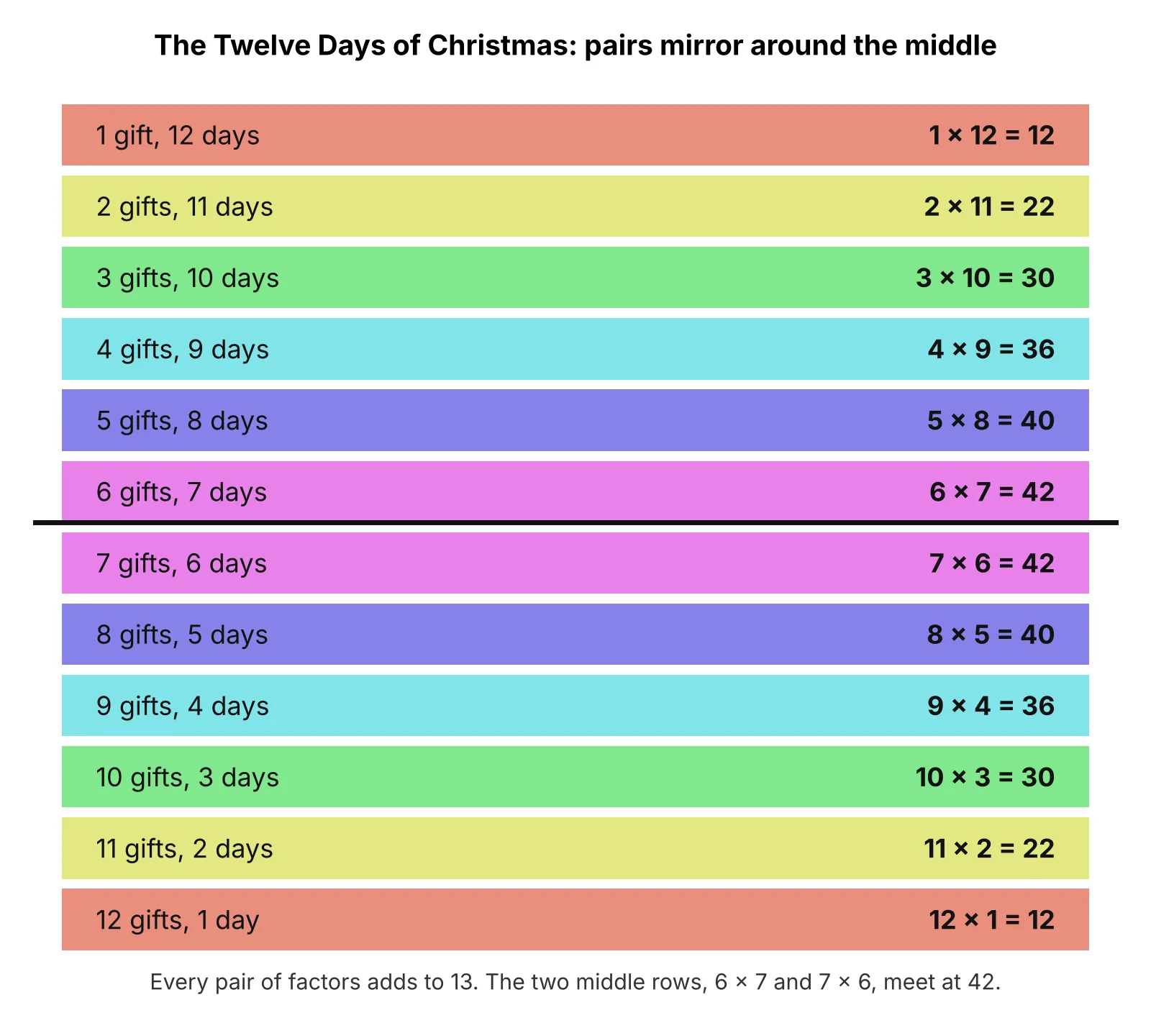
- The Twelve Days of Christmas. Count the gifts that arrive: 1 × 12, 2 × 11, 3 × 10, and so on. The totals mirror around the middle, where 6 × 7 and 7 × 6 meet at 42. Every pair of factors adds to 13 (first figure below).
- The Fibonacci sequence mod 9. It repeats every 24 steps, and the second half is the first half turned into its opposite: each pair adds to 9. This is computed, not just noticed: the 12th Fibonacci number is a multiple of 9, and the 13th leaves a remainder of 8, which is minus 1.
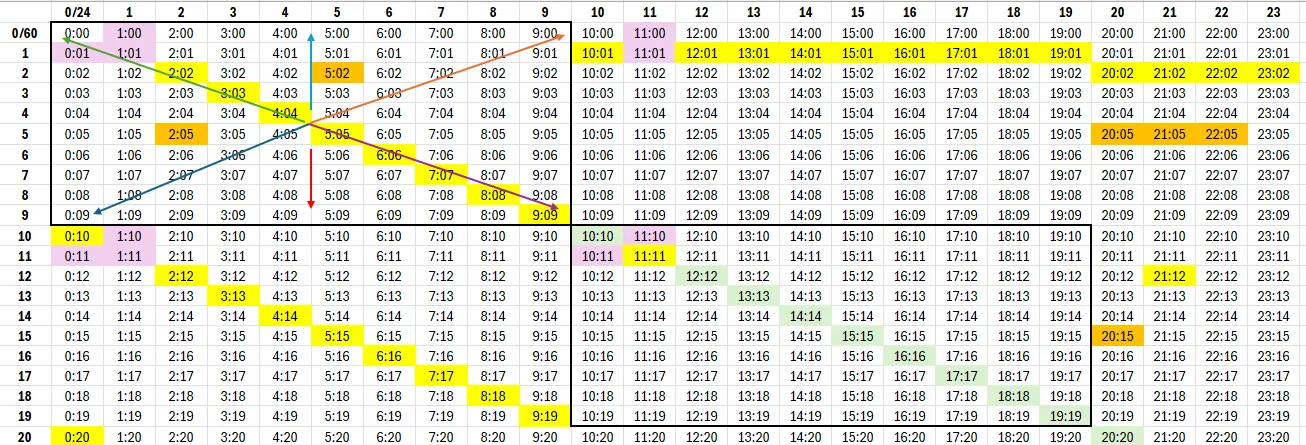
- The clock. Hours and minutes written as a table show the same diagonals and the same pairs (last figure below).
- The week. Count it from Sunday, in the old Chaldean order of the planets: Sun, Moon, Mars, Mercury, Jupiter, Venus, Saturn. Wednesday, Mercury, sits in the middle, the point the hermetic tradition calls the eternal mirror. Tuesday faces Thursday, Mars against Jupiter. Monday faces Friday, Moon against Venus. Sunday opens the week and Saturday closes it. This one is my reading, not a proof.
- Music. In my study of Coltrane's circle, the same symmetry appears: the Coltrane circle study (opens in a new tab).
- Markets. I have tested a version of this on trading charts and wrote a script for it. It is not finished, and nothing here is financial advice, so I leave it out.
 (enlarge picture)
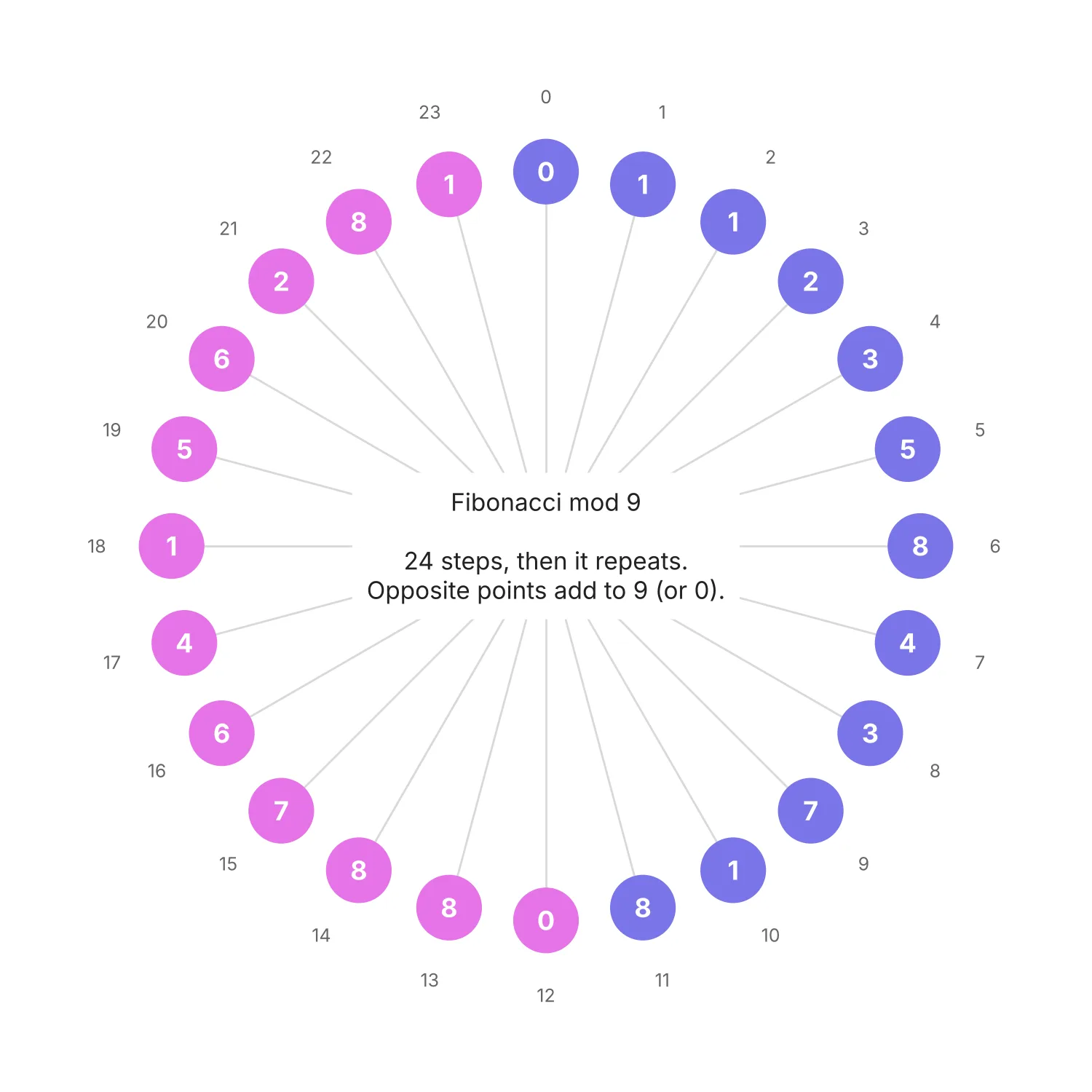 (enlarge picture)
And the clock, with hours down the side and minutes across. The arrows mark the diagonals and the pairs that mirror each other:
 (enlarge picture)
Fibonacci and Lucas: one is the mirror of the other
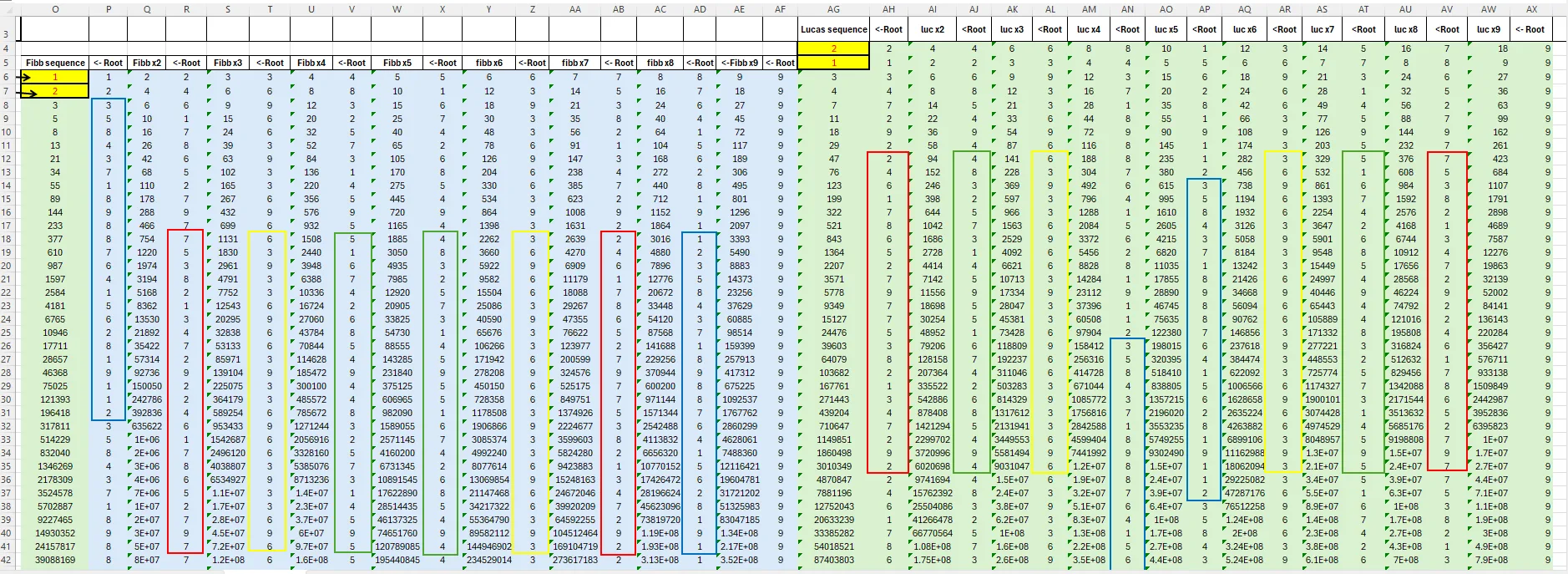
Take the Fibonacci numbers mod 9 and they repeat every 24 steps (the Pisano period). The Lucas numbers do the same. Now multiply each sequence by 2, by 3, by 4, up to 9, and take the digital root every time. Each multiplier gives a new cycle of 24 numbers. The way these cycles line up between the two sequences is one of the clearest mirrors I have found.
 (enlarge picture)
The coloured frames mark cycles that are the same in both sequences. I checked every pair by computer, and they match:
| Fibonacci × | is the same cycle as Lucas × | Frame |
|---|---|---|
| 1 and 8 | 4 and 5 | blue |
| 2 and 7 | 1 and 8 | red |
| 4 and 5 | 2 and 7 | green |
| 3 and 6 | 3 and 6 | yellow |
The yellow pair is the only one that lines up row by row. Fibonacci ×3 is exactly Lucas ×6, both starting 3, 6, 9. Fibonacci ×6 is exactly Lucas ×3, both starting with the flipped 6, 3, 9.
So the Fibonacci numbers themselves (×1) are the Lucas numbers multiplied by 4 or 5, and the Lucas numbers themselves (×1) are the Fibonacci numbers multiplied by 2 or 7. In the table, the framed cycles sit at opposite places: where one sequence has the cycle at its start and end, the other has it in the middle.
There are two reasons behind it, and both are simple. First, inside one sequence the multipliers k and 9 − k give the same cycle, because the second half of the 24 steps is the opposite of the first half. Second, the Lucas numbers mod 9 are the Fibonacci numbers multiplied by 7 and shifted by a few steps (computed), so every multiplier on one side is swapped for another on the other side.
This is the same pairing that I found in the Pentametric Cycle. On my Pentametric Cycle page (opens in a new tab), section 3, the Lucas numbers turn a point one quarter turn clockwise for each Fibonacci square, while the centres of those squares turn at the same rate anticlockwise. The two sequences of rotations are opposites. The table above shows the same opposition in another place, as digital roots.
That suggests a question. I found the areas of the squares from the Lucas numbers. If Fibonacci and Lucas are mirrors of each other, the reverse should be possible too: finding the Lucas number, the distance from the centre of a square to the Holden cross, from the area of that square. That is an idea to test, not a result.
Where it touches the Pentametric Cycle
The palindrome in the Pentametric Cycle and the mirrors in the table come from the same symmetry: n and minus n. The Pentametric number P(n) depends only on n squared and on the Legendre symbol (n | 5), and both stay the same when n becomes minus n (mod 25). That is why the cycle reads the same forwards and backwards, H(25 − n) = H(n). In the table, the same symmetry says (m − n)² leaves the same remainder as n², which is rule 5. This part I can show.
The rest is my reading, and I mark it as such:
- The eight non-zero members of the mod 9 square and the eight origins.
- The ten steps back to the origin of origins, the circle of eight points in my first document.
- The likeness between these mosaics and church windows or cymatic figures. They share the symmetries of a square, which these tables have by rules 2 to 4.
There is a direct link to look for here, and I have not found it yet.
What I do not know yet
I think the mirror belongs to anything that repeats: the seasons, the clock, the week. In my view, numbers are proportions measured from zero, and the sequence 1, 2, 3, 4… is a row of instants, one after another. If a table of those instants shows a mirror, then a cycle in nature, which is also a row of instants, should have one too.
What I cannot yet do is find where the mirror sits in a natural cycle. I do not know whether every cycle has one, whether each cycle has its own, or whether some are too long for the mirror to show yet. A year reveals its midpoint in a way a human life does not, and a week does it faster than either.
This is my interpretation. The five rules are proved, the prime test is checked up to 200, and the rest is a question I would like help with. If you see a mirror somewhere I have not looked, I would like to hear about it.
Cite this
Garcia Torcal, L. (2026-10-30). “The Mirrors in the Torus”. Notebook, Lluis Garcia. https://www.lluisgarcia.es/notebook/2026-10-30-the-mirrors-in-the-torus.html