Research

Independent researcher, no institution. ORCID 0009-0007-8570-2536 (opens in a new tab).

Papers

The preprint, four notes and a data sheet. Read them here or download them.

First page of the preprint The Pentametric Cycle: A Nested Palindrome Encoding the Pythagorean Consonances

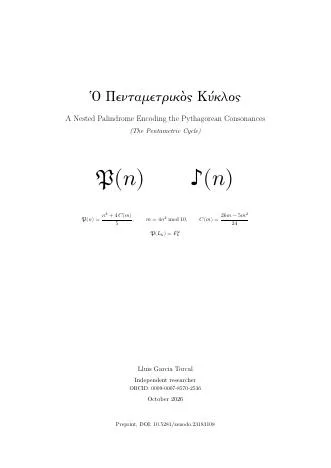
The Pentametric Cycle: A Nested Palindrome Encoding the Pythagorean Consonances

Preprint, 24 pages · October 2026 · doi:10.5281/zenodo.23183108 (opens in a new tab)

The Pentametric Formula 𝔓(n) = (n² + 4(n | 5))/5, its ten equivalent forms, the ±4/5 and ±2π/5 laws, the consonance indicator H(n) with its 25-term palindrome of silences and the four Pythagorean consonances, and the Pentametric–Lucas Theorem 𝔓(L_k) = F_k² with its converse.
First page of the note The Epitetartic Rhombus

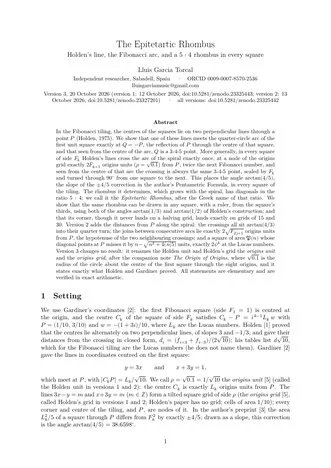
The Epitetartic Rhombus

Note, 8 pages, version 3 · 20 October 2026 · doi:10.5281/zenodo.23325442 (opens in a new tab)

Holden's line meets the first Fibonacci arc at a 3-4-5 point; in every square the crossing lies 2F_{k+1} origins units from P. The 5 : 4 rhombus it determines can be drawn in any square from its thirds, and its corner lands on grids of 15 and 30 but never on a halving grid. Version 2 added the distances from P along the spiral; version 3 renames the Holden unit the origins unit and changes no result.

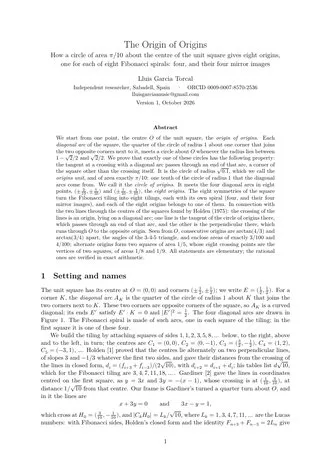
First page of the note The Origin of Origins

The Origin of Origins

Note, 6 pages · 20 October 2026 · doi:10.5281/zenodo.23486276 (opens in a new tab)

From the centre of the unit square alone: exactly one circle about it has tangents, at its crossings with the diagonal arcs, that pass through a corner of the square. It is the circle of radius √0.1 and area π/10, the circle of origins. Its eight crossings (±0.3, ±0.1), (±0.1, ±0.3) are the origins of eight Fibonacci spirals, four and their mirror images.

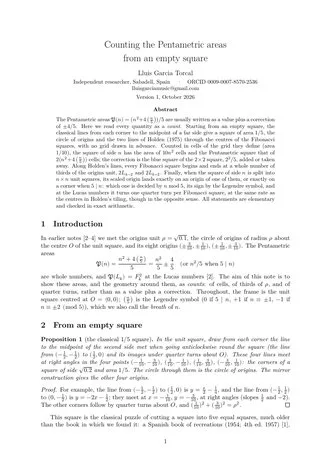
First page of the note Counting the Pentametric areas from an empty square

Counting the Pentametric areas from an empty square

Note, 6 pages · 22 October 2026 · doi:10.5281/zenodo.23571087 (opens in a new tab)

Corner-to-midpoint lines in an empty square give a square of area 1/5 and the origins grid of cells of area 1/10, with no grid drawn. The area 𝔓(n) is then 2(n² + 4(n|5)) cells: the blue square of n, plus or minus the blue square of 2. Fibonacci squares are entered and left at Lucas multiples of thirds of the origins unit; n times Holden's crossing lands a quarter turn on from one Lucas number to the next; and the square of area 2/5 between a square and its mirror is centred on the crossing.

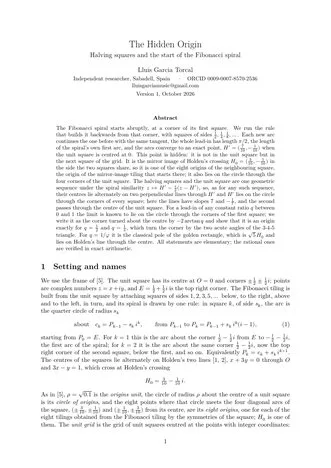
First page of the note The Hidden Origin: halving squares and the start of the Fibonacci spiral

The Hidden Origin: halving squares and the start of the Fibonacci spiral

Note, 6 pages · 23 October 2026 · doi:10.5281/zenodo.23592256 (opens in a new tab)

Run backwards from its first corner with squares of sides 1/2, 1/4, 1/8, …, the Fibonacci spiral continues smoothly and converges to H′ = (7/10, −1/10): the mirror image of Holden's crossing in the side shared with the next square, an origin of that square. The centres lie on lines of slopes 7 and −1/7 through H′. For any ratio q the limit is the corner turned by −2 arctan q; it is an origin exactly for q = 1/2 and q = 1/3, and for q = 1/φ it is the golden pole √5·H₀, on Holden's line.

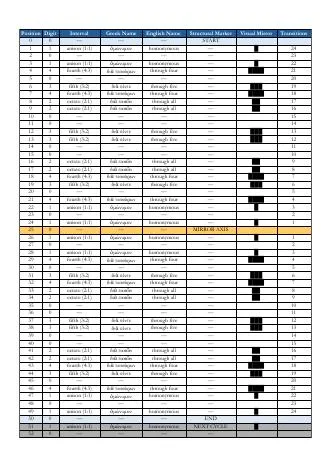
The Pentametric Palindrome data sheet

The Pentametric Palindrome: data sheet

Data sheet, 1 page · October 2026

The digits H(n) = 𝔓(n) mod 5 for n = 0 … 50, position by position: the palindrome as a table.

Papers under journal review are not shown here; their published versions will be linked once they appear.

Publications

OEIS sequences

All my papers and notes: Zenodo (opens in a new tab). My OEIS author page: OEIS (opens in a new tab).

Latest from the Notebook

No notes tagged pentametric yet.